

Khadoor Sahib MP allowed just three hours with his family after nearly three-and-a-half years in detention; family required to pay approximately Rs 10 lakh for travel and security arrangements.
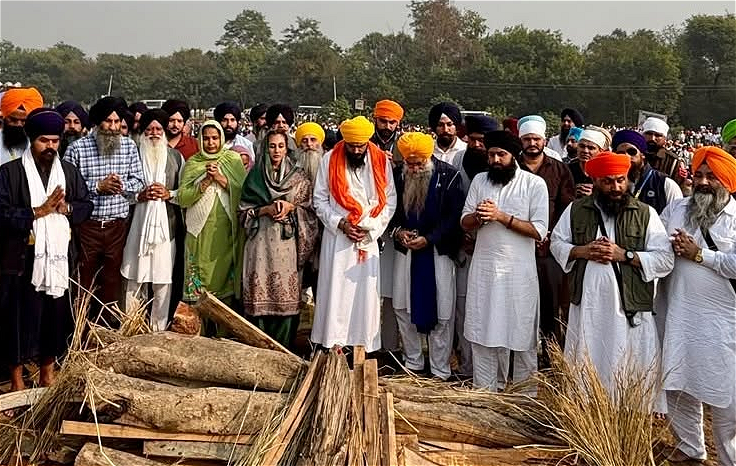
Jallupur Khera, Punjab (KP) — Thousands of people from across Punjab gathered in Jallupur Khera on November 21 to attend the funeral and cremation of Mata Charan Kaur, grandmother of Bhai Amritpal Singh Khalsa, who was granted a brief period of custodial parole to perform her final rites.
The massive gathering reflected the public interest in the return of the imprisoned Sikh leader, with large numbers of young men and women travelling from different districts simply to catch a glimpse of him. Supporters lined the village roads, gathered in adjoining fields and followed the funeral procession as Amritpal Singh accompanied his grandmother’s mortal remains to the cremation ground.
Three Hours With Family After More Than Three Years
Mata Charan Kaur, aged 84, passed away on November 8 following a prolonged illness. Her family had deferred the cremation to allow Amritpal Singh to attend her final rites.
He has been lodged in Dibrugarh Central Jail in Assam since April 2023, initially under the National Security Act (NSA) and subsequently in connection with the Ajnala police station case.
The court imposed several restrictions on his visit. Amritpal Singh was not permitted to address the media or public gatherings, communicate with anyone outside his family, meet members of the public, or visit any location other than his ancestral home and the permitted cremation venue.
Despite the restrictions, the gathering grew into a massive display of public support. Amritpal Singh travelled with his grandmother’s mortal remains on a tractor-trolley towards the cremation ground, approximately three kilometres from the family residence. The cremation concluded peacefully, without any major reported law-and-order incident.
Nearly Rs 10 Lakh for Travel and Security
One of the most controversial aspects of the court’s arrangements was the requirement that Amritpal Singh’s family bear the expenses of transporting him from Dibrugarh to Punjab and providing security for his visit.
According to media reports, the family was required to deposit approximately Rs 10,04,896 with the state government. The estimate included airfare for Amritpal Singh and his police escort, accommodation for police personnel, local transportation, and additional security arrangements.
The arrangement drew criticism because Amritpal Singh is an elected Member of Parliament representing Khadoor Sahib. His family was effectively required to finance not only his travel but also the travel, accommodation and other expenses of the police personnel assigned to escort him.
The restrictions also meant that he was permitted only a brief physical presence at a close family member’s funeral, despite having spent years away from his home and constituency.
Contrast With Repeated Parole Granted to Gurmeet Ram Rahim
The treatment of Amritpal Singh has also revived questions about the unequal application of parole and humanitarian considerations in cases involving Sikh prisoners and other high-profile inmates.
Cultist Rapist Gurmeet Ram Rahim Singh, head of Dera Sacha Sauda, is serving a 20-year prison sentence following his conviction for raping two female disciples. He has also been convicted in a separate murder case.
Despite these convictions, Ram Rahim has repeatedly received parole and furlough. An India Today report published in January 2023 documented that he had received more than 133 days of parole and furlough by that time. His periods outside prison included multiple extended releases, including 40 days in January 2023. The repeated releases drew criticism from Sikh organizations and opposition parties, particularly given the continuing demands for the release of Sikh prisoners who have completed their sentences.
The comparison raises an important question: why are such vastly different conditions imposed when prisoners seek temporary release for family or humanitarian reasons?
For many Sikhs, the issue goes beyond one individual. It reflects a longstanding concern over what they regard as discriminatory treatment of Sikh political prisoners and Bandi Singhs, while individuals convicted of serious crimes have received repeated concessions from the authorities.
Parvinder Singh Jhota’s Father Calls for Release of Bandi Singhs
Among those who travelled to Jallupur Khera to pay their respects was Bhim Singh, father of late anti-drug activist Parvinder Singh Jhota.
Speaking to the media, Bhim Singh expressed condolences to the family and called for the immediate release of Amritpal Singh, his associates and all Bandi Singhs held in prisons across India.
He questioned why democratically elected governments were not respecting humanitarian and democratic principles and urged the authorities to address the longstanding demands concerning Sikh prisoners.
His presence also connected the gathering to the wider concerns raised by families and supporters of Sikh prisoners across Punjab.
The enormous turnout at Mata Charan Kaur’s cremation demonstrated the public attention surrounding the Khadoor Sahib MP. People travelled from different parts of Punjab, many at their own expense, to stand with the family and catch a glimpse of their elected representative.
 Panthic :: A Khalsa Press Publication
